Tirana is not a major world capital, and, not surprisingly, it has a limited flight schedule. The schedule for the entire day was posted, and it consisted of maybe a dozen flights. When I arrived to the airport, passengers for Istanbul had to wait for the London, Vienna, and Budapest flights, which departed earlier, to complete check-in. All flights funneled through the same handful of check-in counters.
With nothing much to do for an hour, I went to the bathroom to kill some time. What with the diarrhea I had picked up in Albania, any time was toilet time.
A squat toilet is no place to linger, so I was probably in the stall for a minute at the most. Then I washed my hands and stood at the hand dryer for a moment. As I was drying my hands, a man entered the bathroom and gave me a boisterous, “What’s up, man?” Actually, not much was up. It was a bit weird, though, to be greeted in English after a weekend of communication difficulties.
Back out in the waiting area, I took a seat and stared at the other people loitering around. As I was people-watching, a group of contestants from the Miss Globe International 2006 beauty pageant entered. I had never heard of this particular beauty pageant before. This along with the fact that it has been held in Albania for the past three years led me to the conclusion that this event was not really the big leagues of pageantry.
The young beauty queens were wearing their pageant sashes, so it was easy to tell from where they hailed. On hand we had Miss India, Miss Hungary, Miss Philippines, Miss Singapore, Miss Malaysia, and a blond woman who I think was representing Sweden. All but Sweden and Hungary would be on my flight.
These young ladies were all attractive, obviously. Incidentally, though, none of them were winners, except in the bogus sense that everyone who participated was a winner.
Anyhow, the ladies sat in some chairs about 15 feet from me and started talking. Miss Philippines was busy stuffing packs of cheap cigarettes into every compartment in her luggage.
Speaking of bags, Miss Hungary had about 20 pieces of carry-on luggage. She was traveling with a colorful individual – a fat man wearing a pink shirt, camouflage pants, and a red headband – who schlepped her things around for her. All and all, she seemed a bit high-maintenance.
Meanwhile, a group of Muslim Albanian men (as evidenced by their beards and WWMD [What would Muhammad do?] bracelets) entered the airport and staked themselves out near the check-in counters so that they would be in the front of the line once things got moving.
I watched the clock for a while longer, and soon enough it was time for us to check-in. When it came to be my turn, the agent issued me a boarding pass for both my Tirana-Istanbul and Istanbul-Tel Aviv segments. And what’s more, she upgraded me to business class on the Tel Aviv flight. Boy howdy!
Passport control went quickly, and then I got to security. I was traveling light, so there wasn’t much to scrutinize. There was one thing, though. One souvenir that I had purchased in Tirana was a wooden stick that was about three feet long with a forked end. Though actually something used for weaving, it looked like a big wooden grilling fork.
The Albanian security agent was like, “What’s this?”
I told him that it was for killing Dracula. We had a laugh, and I got to carry my wooden fork on the plane.
I told him that it was for killing Dracula. We had a laugh, and I got to carry my wooden fork on the plane.
In the departure lounge, there were a few crappy duty free stores, a café, bathrooms, a CD/DVD store, and a jewelry store. I like foreign movies and music, so I went to the music and movies store. I asked the clerk when I entered if she took credit cards, and she said she did.
I proceeded to select several items with the saleswoman’s help, and with my selections stacked on the counter, I pulled out my Mastercard. Then the woman realized that she didn’t take credit cards afterall. This was no shocker since credit cards didn’t seem to be widely used in Albania, but it was a bit annoying since I had asked her about credit cards not ten minutes earlier. With the Mastercard out of the picture, I checked my stash of cash. I had only enough leke remaining to purchase one DVD, so I put everything else back.
Then I sat out in the departure lounge and waited for boarding to begin. There were three departure gates, and Istanbul was assigned to Gate 2. As our scheduled boarding time approached and then passed, several of the passengers got restless and started pacing back and forth between the gates to see if the Istanbul gate assignment had changed. I just kept watching to make sure that there was still a substantial number of my fellow Istanbul-bond passengers around.
Even after boarding was half an hour late, it was still showing on the departure board as on-time. Then it dropped off the board altogether.
The Muslims started praying in the front of the lounge, and everyone watched. There was no TV in the area, so entertainment was hard to come by.
When the bus finally ferried us out to the plane, we were probably 45 minutes to an hour behind schedule.
I had the window seat, and for the longest time, no one else was sitting in my row. The last two passengers on the plane, however, were my row-mates. They were two young guys who were part of the larger Muslim delegation.
They both had cell phones and continued texting and talking until we were practically in the air. As we took off, I got the distinct impression that my two companions had never flown before. My first clue was that they were constantly crawling over me to look out the windows. This carried on throughout the flight, and I didn’t much mind. Still, it’s a bit awkward to constantly have someone a few inches from your face.
These guys, especially the one right next to me, were curious fellows, and as soon as we reached altitude, they pushed the buzzer to summon a flight attendant. One came back to our row, and the guy next to me asked her, “Where are we now?”
He was not a native English speaker, and neither was she. The guy repeated the question a few times, and the flight attendant never did understand. A bit perturbed, my seat-mate was like, “You don’t know? Okay.”
This was funny. She could not understand his Albanian-accented English, and he couldn’t understand her Turkish accent.
When the stewardess left, the two guys in my row repeated the phrase, “Where are we now?” over and over again, with a variety of vocal inflections. The guy next to me was like, “Why doesn’t she listen?”
Meanwhile, according to press accounts, but unbeknownst to us passengers:
Twenty minutes into the flight, the captain summoned a flight attendant into the cabin to take a beverage order. When the flight attendant entered, a Turkish passenger followed her inside the cabin, threw her against the wall, and told the pilots that he was hijacking the plane. The Turkish man, later identified as Hakan Ekinci, presented no weapon, but told the captain that he had accomplices in the plane and that they were prepared to blow it up if demands were not met. [Numbers of supposed accomplices that I’ve seen in the press range from one to six.] At this news, the captain entered the code for a distress signal to show that there was an onboard emergency. The hijacker, however, was savvy to distress codes, thanks to supposedly studying them on the internet, and he told the pilot to turn off the general emergency signal and instead transmit the hijacking signal. The captain did as instructed. The hijacker also demanded that the plane be diverted to Rome. This was so he could talk to the Pope.
At the time we were flying over Greece. The hijacking signal was received, and two Greek Air Force fighter jets took to the skies and shadowed our plane. None of us saw them.
Back in the fuselage of oblivion, we were all zoned out. My companions asked another flight attendant who was passing by the old, “Where are we now?” There was more confusion, so I repeated the question for them. The woman was like, “I don’t know.” Then she walked on.
My small bit of assistance opened the door for a dialog, and soon my seatmate and I were properly introduced. His name was Saymir, and he was a part of a group of 20 men who were on their way to Saudi for hajj. His English was basic, and he also spoke basic Arabic. The other guy next to Saymir was also part of the hajj group, but he basically didn’t speak English and was not part of our conversation.
A second after the flight attendant left us, the captain came on the speaker: “Attention, ladies and gentleman: Due to a technical problem, we are making an emergency landing in Italia.” Then he gave the same announcement in Turkish.
My Albanian companions, like most of the Albanian passengers, were clueless as to what had just been said. I explained the message to Saymir, who thought that the captain must have meant to say Antalya (a city in Turkey) as opposed to Italia.
I told him that maybe he was right, and really, it didn’t make much difference to me. I had about a five-hour cushion once we landed to get to my connecting flight, so I figured that even with a momentary delay, I could still keep my schedule.
Saymir and I continued talking as our plane made a huge U-turn in the sky. He asked my religion, and I told him I was Catholic. At this, he asked me what I knew of his religion. I know most of the basics, plus I lived in Pakistan (a Muslim country) for two years, plus I have read the Koran. So, I knew more than enough to impress him – not that the threshold was very high.
Meanwhile, according to press accounts, but unbeknownst to us passengers:
We left Greek territory, and the Italian Air Force took over escort duty. In the cabin, the captain told the hijacker that we didn’t have enough fuel to go all the way to Rome and that we would have to land in Brindisi, a city in the heel of the Italian boot, almost directly across the Adriatic Sea from Tirana. The hijacker bought this. What a sucker.
Back in the fuselage of oblivion, Saymir and I had run out of conversation so we both read our in-flight magazines.
Before long, after what seemed like less than an hour into our flight, we made our landing approach. As we got lower and lower over the Adriatic Sea, my companions were again leaning into my space so that they could see out the window.
Saymir, still standing by his Antalya theory, commented, “This must be the Black Sea.”
By now, the supposed reason for our emergency landing – a technical problem – was prominent in my mind. This obviously implied that something was wrong with the plane, and as the plane went through the landing process, I focused intently on the wing out my window, lest it should fall off or something. As I watched the wing, I noticed a few loose screws and a lot of shaking in one of the flaps. Obviously, though, we were not landing because of any problems with the plane, and these things I was noticing were not serious issues.
As we settled on the runway, several fire trucks and other emergency vehicles were racing toward us. This only added to the notion that our plane was going to fall apart at any moment.
The landing was a bit rough, but nothing too bad. This was probably because the pilot was feeling the pressure of the situation that the rest of us knew nothing about. A few people cheered as the pilot fired the engines in reverse and slowed us down. Then the plane stopped on the tarmac.
Saymir looked out the window. “This isn’t Turkey,” he remarked.
As happens on every flight the instant that the plane stops, people threw off their seatbelts and started leaping out of their seats. The flight attendants came back and scolded everyone. “Get in your seats until the seatbelt sign is turned off. Do not stand up. Turn off your mobile phones.”
Everyone followed the instructions from the crew for maybe three or four minutes. After that, random people continued getting up to rummage in the overhead bins and whatnot. These people would get scolded, but the flight attendants were focused on other things, so it wasn’t difficult for someone to get something from his bag and return to his seat unhassled.
Everyone who had a cell phone was calling someone. The whole scene was pretty much one of fun and games. Everyone was chatting away, and no one seemed the least bit worried.
The captain came back on the intercom: “Attention passengers: The tower would like to know if there are any Italians on this flight. If you are Italian, please notify the flight crew.”
I explained this message to Saymir, who didn’t understand the meaning of Italian. Then he didn’t understand the word citizen, which was part of my explanation. Finally, I told him that the pilot wanted to know if anyone had a passport from Italy, and Saymir understood.
Meanwhile, the Albanian man behind us had been trying to follow our discussion. Out of the blue, he chimed in, “I speak Italian.” So, I had Saymir to explain in Albanian what I had just explained in English.
With the Italian citizen question, this was seeming less and less like a technical problem. Oh, and there were no Italians onboard.
After a bit, Saymir, my only link to English in the vicinity, began completely neglecting me and talking with his companions in Albanian. I had already read the in-flight magazine several times, and I was getting bored.
He turned to me after 20 minutes or so and said, “Don’t be worried, my brother.” I told him that I was more bored than worried. After this, he would periodically check on me by asking, “Are you boring, Chris?”
The confusion with bored and boring is a classic among non-native English speakers, and it always amuses me. Of course, every time Saymir would ask me if I was boring, I would tell him yes. In my isolation, how could I not be?
Soon people started barking for food and water. The time came for the Muslims who were fasting for Ramadan to break the fast. The rest of us had also not eaten for several hours and were also hungry.
In response, a flight attendant came back with like five sandwiches in her hands for 107 passengers. All of the people were shouting “me, me, me!” and sticking their hands out. The sandwiches didn’t get far.
The flight attendant left and returned with another small stash of sandwiches. They were again quickly claimed. All told, probably only 30 people got anything to eat.
The same thing happened with the water. The flight attendant brought out like a dozen bottles for 107 of us, and people snatched them up well before they got to row 15 where I was sitting.
I got neither food nor water, and I started thinking to myself, “Worst service ever…”
Some people who didn’t get any food got an enough-is-enough attitude and tromped up the aisle to the galley. They returned clutching sandwiches in their greedy paws, and more and more people started going up to the front.
Before long, several people were milling about the plane. The flight attendants would come back periodically, and people would sort of get back to their seats.
A lot of people were really hankering a smoke, which obviously wasn’t allowed on an airplane, even one that was stopped. Several guys had unlit cigarettes hanging out of their mouths as they waited for a chance to light up.
Early on, we were instructed not to use the bathrooms, and I think most people obeyed this directive. Luckily, there were no babies or children on the flight. A crying baby or a bratty kid could have made everything much worse.
As people were walking around, some started going up front and returning with intelligence. The plane was abuzz with Albanian, but I couldn’t understand a lick of it. Actually, that’s not true. The word in Albanian for terrorist is very similar to the English word. In any case, I was eventually informed that there were terrorists in business class.
Besides the people walking around the plane, intel was also coming in via cell phone. Soon after the plane had been hijacked, it was on the news. This meant that people who weren’t on the plane knew more about the situation than those of us onboard.
Twenty minutes into the flight, the captain summoned a flight attendant into the cabin to take a beverage order. When the flight attendant entered, a Turkish passenger followed her inside the cabin, threw her against the wall, and told the pilots that he was hijacking the plane. The Turkish man, later identified as Hakan Ekinci, presented no weapon, but told the captain that he had accomplices in the plane and that they were prepared to blow it up if demands were not met. [Numbers of supposed accomplices that I’ve seen in the press range from one to six.] At this news, the captain entered the code for a distress signal to show that there was an onboard emergency. The hijacker, however, was savvy to distress codes, thanks to supposedly studying them on the internet, and he told the pilot to turn off the general emergency signal and instead transmit the hijacking signal. The captain did as instructed. The hijacker also demanded that the plane be diverted to Rome. This was so he could talk to the Pope.
At the time we were flying over Greece. The hijacking signal was received, and two Greek Air Force fighter jets took to the skies and shadowed our plane. None of us saw them.
Back in the fuselage of oblivion, we were all zoned out. My companions asked another flight attendant who was passing by the old, “Where are we now?” There was more confusion, so I repeated the question for them. The woman was like, “I don’t know.” Then she walked on.
My small bit of assistance opened the door for a dialog, and soon my seatmate and I were properly introduced. His name was Saymir, and he was a part of a group of 20 men who were on their way to Saudi for hajj. His English was basic, and he also spoke basic Arabic. The other guy next to Saymir was also part of the hajj group, but he basically didn’t speak English and was not part of our conversation.
A second after the flight attendant left us, the captain came on the speaker: “Attention, ladies and gentleman: Due to a technical problem, we are making an emergency landing in Italia.” Then he gave the same announcement in Turkish.
My Albanian companions, like most of the Albanian passengers, were clueless as to what had just been said. I explained the message to Saymir, who thought that the captain must have meant to say Antalya (a city in Turkey) as opposed to Italia.
I told him that maybe he was right, and really, it didn’t make much difference to me. I had about a five-hour cushion once we landed to get to my connecting flight, so I figured that even with a momentary delay, I could still keep my schedule.
Saymir and I continued talking as our plane made a huge U-turn in the sky. He asked my religion, and I told him I was Catholic. At this, he asked me what I knew of his religion. I know most of the basics, plus I lived in Pakistan (a Muslim country) for two years, plus I have read the Koran. So, I knew more than enough to impress him – not that the threshold was very high.
Meanwhile, according to press accounts, but unbeknownst to us passengers:
We left Greek territory, and the Italian Air Force took over escort duty. In the cabin, the captain told the hijacker that we didn’t have enough fuel to go all the way to Rome and that we would have to land in Brindisi, a city in the heel of the Italian boot, almost directly across the Adriatic Sea from Tirana. The hijacker bought this. What a sucker.
Back in the fuselage of oblivion, Saymir and I had run out of conversation so we both read our in-flight magazines.
Before long, after what seemed like less than an hour into our flight, we made our landing approach. As we got lower and lower over the Adriatic Sea, my companions were again leaning into my space so that they could see out the window.
Saymir, still standing by his Antalya theory, commented, “This must be the Black Sea.”
By now, the supposed reason for our emergency landing – a technical problem – was prominent in my mind. This obviously implied that something was wrong with the plane, and as the plane went through the landing process, I focused intently on the wing out my window, lest it should fall off or something. As I watched the wing, I noticed a few loose screws and a lot of shaking in one of the flaps. Obviously, though, we were not landing because of any problems with the plane, and these things I was noticing were not serious issues.
As we settled on the runway, several fire trucks and other emergency vehicles were racing toward us. This only added to the notion that our plane was going to fall apart at any moment.
The landing was a bit rough, but nothing too bad. This was probably because the pilot was feeling the pressure of the situation that the rest of us knew nothing about. A few people cheered as the pilot fired the engines in reverse and slowed us down. Then the plane stopped on the tarmac.
Saymir looked out the window. “This isn’t Turkey,” he remarked.
As happens on every flight the instant that the plane stops, people threw off their seatbelts and started leaping out of their seats. The flight attendants came back and scolded everyone. “Get in your seats until the seatbelt sign is turned off. Do not stand up. Turn off your mobile phones.”
Everyone followed the instructions from the crew for maybe three or four minutes. After that, random people continued getting up to rummage in the overhead bins and whatnot. These people would get scolded, but the flight attendants were focused on other things, so it wasn’t difficult for someone to get something from his bag and return to his seat unhassled.
Everyone who had a cell phone was calling someone. The whole scene was pretty much one of fun and games. Everyone was chatting away, and no one seemed the least bit worried.
The captain came back on the intercom: “Attention passengers: The tower would like to know if there are any Italians on this flight. If you are Italian, please notify the flight crew.”
I explained this message to Saymir, who didn’t understand the meaning of Italian. Then he didn’t understand the word citizen, which was part of my explanation. Finally, I told him that the pilot wanted to know if anyone had a passport from Italy, and Saymir understood.
Meanwhile, the Albanian man behind us had been trying to follow our discussion. Out of the blue, he chimed in, “I speak Italian.” So, I had Saymir to explain in Albanian what I had just explained in English.
With the Italian citizen question, this was seeming less and less like a technical problem. Oh, and there were no Italians onboard.
After a bit, Saymir, my only link to English in the vicinity, began completely neglecting me and talking with his companions in Albanian. I had already read the in-flight magazine several times, and I was getting bored.
He turned to me after 20 minutes or so and said, “Don’t be worried, my brother.” I told him that I was more bored than worried. After this, he would periodically check on me by asking, “Are you boring, Chris?”
The confusion with bored and boring is a classic among non-native English speakers, and it always amuses me. Of course, every time Saymir would ask me if I was boring, I would tell him yes. In my isolation, how could I not be?
Soon people started barking for food and water. The time came for the Muslims who were fasting for Ramadan to break the fast. The rest of us had also not eaten for several hours and were also hungry.
In response, a flight attendant came back with like five sandwiches in her hands for 107 passengers. All of the people were shouting “me, me, me!” and sticking their hands out. The sandwiches didn’t get far.
The flight attendant left and returned with another small stash of sandwiches. They were again quickly claimed. All told, probably only 30 people got anything to eat.
The same thing happened with the water. The flight attendant brought out like a dozen bottles for 107 of us, and people snatched them up well before they got to row 15 where I was sitting.
I got neither food nor water, and I started thinking to myself, “Worst service ever…”
Some people who didn’t get any food got an enough-is-enough attitude and tromped up the aisle to the galley. They returned clutching sandwiches in their greedy paws, and more and more people started going up to the front.
Before long, several people were milling about the plane. The flight attendants would come back periodically, and people would sort of get back to their seats.
A lot of people were really hankering a smoke, which obviously wasn’t allowed on an airplane, even one that was stopped. Several guys had unlit cigarettes hanging out of their mouths as they waited for a chance to light up.
Early on, we were instructed not to use the bathrooms, and I think most people obeyed this directive. Luckily, there were no babies or children on the flight. A crying baby or a bratty kid could have made everything much worse.
As people were walking around, some started going up front and returning with intelligence. The plane was abuzz with Albanian, but I couldn’t understand a lick of it. Actually, that’s not true. The word in Albanian for terrorist is very similar to the English word. In any case, I was eventually informed that there were terrorists in business class.
Besides the people walking around the plane, intel was also coming in via cell phone. Soon after the plane had been hijacked, it was on the news. This meant that people who weren’t on the plane knew more about the situation than those of us onboard.
Even as the news of the terrorists was circulating around the plane, there didn’t seem to be an ounce of concern from anyone. I don’t know why, but I also didn’t care. I just wanted to get going.
At about this time, the captain was once again on the speaker: “Attention passengers: Is there a doctor on the plane? Is there a doctor on the plane?”
After a long pause, no one stepped forward. Then three or four people went to the front of the plane. I think that these people were not doctors but did have some medical training. They had decided to go forth when it was apparent to them that no doctors were on the plane.
This caused a bit of a stir among the passengers, but the excitement died quickly. It turned out that an elderly passenger had gotten dehydrated or something boring like that.
The flight attendants continued to come to the back of the plane to keep people in line. Each time they would appear, people would barrage them with questions. Unprepared to offer any information, they continued to repeat the party line about technical difficulties.
Some of these flight attendants were rattled and clearly stressed out. Others were calm and even enjoyed some laughs with the passengers.
A few of the passengers finally got irritated and demanded answers. One short, stocky man, who I would later learn was an American bound for Chicago, shouted at the flight attendant. “This is ridiculous! We have a right to know what is happening!”
He got no answers, though, and the other passengers helped pacify him. This also happened with another man.
In order to communicate better, the flight crew enlisted the help of a passenger who could speak Albanian and Turkish. It seemed that they set him out delivering the same uninformative messages as they had been giving before.
I didn’t have a watch, but after what seemed like hours, the passengers were getting a bit testy. I don’t know if it was in response to this or not, but suddenly the plane lost power. The main lights turned off, the emergency lights turned on, and we lost our precious A/C. Everyone shut their yap, though, and the plane was quiet for a few minutes.
The view out my side of the plane – the right side – was boring. All I could see were three big, stationary emergency vehicles. On the left side, though, I could tell that there was more happening. It was the side the doors were on, afterall.
When the power switched back on, the air conditioning did not return immediately. All throughout the plane, people were adjusting their air nozzles, trying to get more air. There was none to be had, though.
After several more minutes, we had air again.
People went back to chatting and getting irritable.
Then, things began to resolve.
There had been people taking photos throughout the ordeal, and all of the sudden, everyone was training their cameras and camera phones up the aisle. Having the window seat, I couldn’t really see what was happening all that well.
Then the hijacker stood in the middle of the aisle at the barrier separating business class from steerage class. He was smiling and waving, and the passengers in turn started cheering and clapping and waving back. It was bizarre to be sure. There were dozens of photographs and videos made of that moment. Sadly, though, I didn’t get a piece of the action.
Saymir was clearly excited as he turned to me: “It’s the terrorist! I was talking to this guy at Rinas!” [Rinas is the informal name for Mother Teresa Airport.]
I’m not sure what all the cheering was about. Maybe people were just glad that the ordeal was over.
The hijacker, now surrendering, turned and walked down the air stairs toward the waiting authorities with his hands up. During the entire ordeal, he had remained in business class, talking with members of the flight crew. He never came back into the economy section, and as far as I could tell, he didn’t interact with any passengers.
A moment after the hijacker left the plane, police entered. Again came the cheering and clapping from the passengers.
There were still people roaming around the plane as the police came aboard. The police didn’t bother to force everyone to sit down, so as they tried to count the passengers, they kept getting off track.
Several policemen passed through the plane to count us. Then one of them addressed us: “Take all of your things and depart the plane. After a few checks, we will reload, and you will be on your way.”
At about this time, the captain was once again on the speaker: “Attention passengers: Is there a doctor on the plane? Is there a doctor on the plane?”
After a long pause, no one stepped forward. Then three or four people went to the front of the plane. I think that these people were not doctors but did have some medical training. They had decided to go forth when it was apparent to them that no doctors were on the plane.
This caused a bit of a stir among the passengers, but the excitement died quickly. It turned out that an elderly passenger had gotten dehydrated or something boring like that.
The flight attendants continued to come to the back of the plane to keep people in line. Each time they would appear, people would barrage them with questions. Unprepared to offer any information, they continued to repeat the party line about technical difficulties.
Some of these flight attendants were rattled and clearly stressed out. Others were calm and even enjoyed some laughs with the passengers.
A few of the passengers finally got irritated and demanded answers. One short, stocky man, who I would later learn was an American bound for Chicago, shouted at the flight attendant. “This is ridiculous! We have a right to know what is happening!”
He got no answers, though, and the other passengers helped pacify him. This also happened with another man.
In order to communicate better, the flight crew enlisted the help of a passenger who could speak Albanian and Turkish. It seemed that they set him out delivering the same uninformative messages as they had been giving before.
I didn’t have a watch, but after what seemed like hours, the passengers were getting a bit testy. I don’t know if it was in response to this or not, but suddenly the plane lost power. The main lights turned off, the emergency lights turned on, and we lost our precious A/C. Everyone shut their yap, though, and the plane was quiet for a few minutes.
The view out my side of the plane – the right side – was boring. All I could see were three big, stationary emergency vehicles. On the left side, though, I could tell that there was more happening. It was the side the doors were on, afterall.
When the power switched back on, the air conditioning did not return immediately. All throughout the plane, people were adjusting their air nozzles, trying to get more air. There was none to be had, though.
After several more minutes, we had air again.
People went back to chatting and getting irritable.
Then, things began to resolve.
There had been people taking photos throughout the ordeal, and all of the sudden, everyone was training their cameras and camera phones up the aisle. Having the window seat, I couldn’t really see what was happening all that well.
Then the hijacker stood in the middle of the aisle at the barrier separating business class from steerage class. He was smiling and waving, and the passengers in turn started cheering and clapping and waving back. It was bizarre to be sure. There were dozens of photographs and videos made of that moment. Sadly, though, I didn’t get a piece of the action.
Saymir was clearly excited as he turned to me: “It’s the terrorist! I was talking to this guy at Rinas!” [Rinas is the informal name for Mother Teresa Airport.]
I’m not sure what all the cheering was about. Maybe people were just glad that the ordeal was over.
The hijacker, now surrendering, turned and walked down the air stairs toward the waiting authorities with his hands up. During the entire ordeal, he had remained in business class, talking with members of the flight crew. He never came back into the economy section, and as far as I could tell, he didn’t interact with any passengers.
A moment after the hijacker left the plane, police entered. Again came the cheering and clapping from the passengers.
There were still people roaming around the plane as the police came aboard. The police didn’t bother to force everyone to sit down, so as they tried to count the passengers, they kept getting off track.
Several policemen passed through the plane to count us. Then one of them addressed us: “Take all of your things and depart the plane. After a few checks, we will reload, and you will be on your way.”
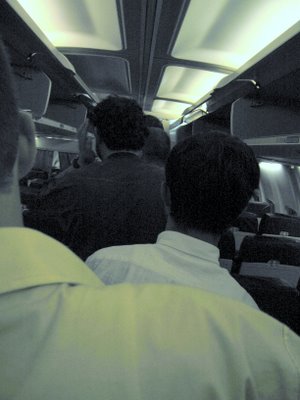
As always happens, we all grabbed our things and piled into the aisle. The line was barely moving, though. This was because the passengers were being thoroughly scrutinized at a handful of stations as they left the plane.
When I finally got close to the door, I was still near Saymir and his companion. The captain had left his hat near the exit, and Saymir’s friend put it on and posed for a variety of photos at the door. There’s always time for clowning around.
The crew members were standing on the top of the air stairs, and all of the passengers, especially the ones who had gotten combative, were overly affectionate toward them. People were shaking hands and hugging and patting backs and high-fiving. Also on the top of the air stairs, about 20 passengers were piled up, waiting to be processed.
Stepping out of the door, it was clear that the left side of plane was more interesting than the right side. There were several fire trucks and a wide variety of police vehicles. There were police everywhere. A few of the policemen were making videos of the scene, most were processing passengers, and a lot were just standing around.
When my turn came, I walked down the stairs to be processed. For this, they first took my passport, and one guy recorded all of my details in a notebook. Then they patted me down. During the frisking, the policeman made me remove everything from my pockets, and he inspected these things also. This joker even looked through all of the contents of my wallet.
I was traveling on my diplomatic passport, which is what I surrendered at first. I was also carrying my tourist passport, however, and the frisker found this during his check. He was confused at the two passports, but his partner told him it was fine.
After the policeman had checked everything on my body, he went through my bag. Several things caught his attention. Some items of interest like my digital camera battery charger were maybe understandable. Some were less so. At one point, the cop was holding my camera tripod asking, “What is this for?”
I was thinking, “Well, duh. They don’t have tripods in Italy?” but, of course, I played nice and told him that it went with my camera.
He also didn’t like my pitch fork stick or my alarm clock, but he didn’t make a big deal about them. I had purchased seven CDs and DVDs in Albania, and the cop opened all of these to inspect the contents. Nope, no bombs in there either. Then the checking was finished, and he crammed everything back inside my bag. Well, everything except for the things he forgot. I pointed these things out, and he dutifully crammed them inside also.
Then I got my passports and my bag, and I boarded the waiting bus. Miss India was on the bus trying to find a cell phone she could use to call her father, but everyone had supposedly run their batteries down.
It was taking a long time for the bus to fill up, so I decided to take a few pictures while I waited. Other passengers were taking photos and making videos all around the scene, so I thought nothing of it.
He also didn’t like my pitch fork stick or my alarm clock, but he didn’t make a big deal about them. I had purchased seven CDs and DVDs in Albania, and the cop opened all of these to inspect the contents. Nope, no bombs in there either. Then the checking was finished, and he crammed everything back inside my bag. Well, everything except for the things he forgot. I pointed these things out, and he dutifully crammed them inside also.
Then I got my passports and my bag, and I boarded the waiting bus. Miss India was on the bus trying to find a cell phone she could use to call her father, but everyone had supposedly run their batteries down.
It was taking a long time for the bus to fill up, so I decided to take a few pictures while I waited. Other passengers were taking photos and making videos all around the scene, so I thought nothing of it.
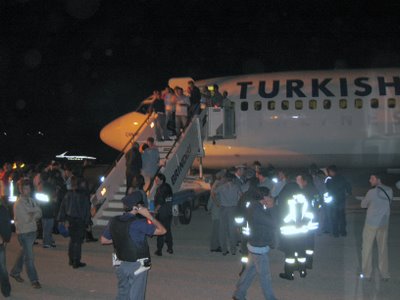
I took a few shots without flash, but the vibration of the bus caused too much blur. I put down the window and took a picture with flash. And in about five seconds, I had three new friends standing outside the window – two uniformed policemen and one guy looking preppy with a green and white striped sweater draped over his shoulders. Sweater Guy was wearing his badge around his neck.
The policemen got my attention, and Sweater Guy spoke. “Did you take a picture?” he asked, “This is not possible.”
I had taken a picture, so obviously it was possible.
I told him that I had indeed taken a photo.
He was fumbling around for the words in English, I so asked if he wanted the camera. He did, so I passed it through the window. The three policemen fooled around with it for a bit, so I asked them if they wanted me to turn the pictures on. Sweater Man waved me off, indicating that he didn’t need my help with the camera. I told them that they just had to push the green button, but they weren’t listening. Soon enough, though, Sweater Man handed the camera back to me and told me to show the pictures.
I was happy to oblige. I put the camera in review mode. Before I passed it back, though, I pushed the button to advance the photos. Since the camera automatically started at the last shot, in hitting the advance button once, I moved the first photo of my vacation onto the screen.
The police took the camera, and I told them to just push the arrow to go to the next photo. They nodded and started scrolling. Since I had started them at the beginning, they had over 200 photos to get through before they would get to the picture they wanted to see. As I watched from the windows, they scrolled and scrolled and scrolled and discussed my pictures of Albania amongst themselves. They were only at about photo 150 when Sweater Man started losing interest. Then my bus started moving. Sweater Man was like, “never mind,” and he handed my camera back through the window.
There were two policemen on the bus with us, and we also had a police car escort.
The bus took us to the terminal at the tiny Brindisi Airport, and as we entered, a ticket agent handed us transit passes.
Inside, there was a spread of food with an Italian flava. There were fresh calzones, cheese sandwiches, and prosciutto sandwiches, as well as prepackaged sandwiches. To drink, there was a choice of water, Pepsi, beer, lemon soda, tea, and several juices. Everyone gorged on this food and then sat around, fat and almost happy, waiting for information. We were confined to the small area at Gate 1.
All of the smokers were back in flavor country. The terminal was not set up for smoking, so people just dropped their ashes and butts on the floor. No one seemed to mind this, though, and the police were actually doing the same thing.
Meanwhile, it was time for more praying. The Muslim men were permitted to go to the Gate 2 waiting room to pray, and they were visible to the rest of us through the glass. Again, we all watched them for lack of anything better to do.
In the Gate 1 area, everyone just sat around chatting. There was one phone there, and a queue quickly developed. The bathroom was also popular.
The passengers on the flight were mostly Albanians. In addition, there were a few Turks, four Americans (including the stocky man who had demanded answers on the plane, an older man who worked for the Peace Corps in Albania, Miss India, and me), an Australian, a Kyrgyzstani, and one each from Singapore, Philippines, and Malaysia (the three other beauty queens).
As we waited in the Gate 1 area, the police took the Aussie and the Americans a few at a time to the police office so that we could call our consuls. When it was my turn, I was taken to the office with the Aussie woman. They connected her first, and she had her consul call her daughter and husband to tell them that she was fine. Then it was my turn. When the policewoman called the American consul in Naples for me, she told me that there was no answer. I was sent back out to Gate 1 and told that someone would retrieve me when the consul answered. No one ever did get me, though.
Out in the holding area, the police again collected our passports. They were entering the information into a computer, and they were also making photocopies of everyone’s passport except for those belonging to the Americans and the Aussie. I had seen this work in progress as I was waiting to talk to my consul.
Even though I had not gotten to speak with a consul, the Italians were on top of things. Somehow, information about us Americans had reached the State Department Operations Center in Washington. I assume that the Italians sent this information to our Embassy in Rome and that it was forwarded to Washington from there.
In any case, my good friend Nicole, who was back in Tel Aviv serving as the after-hours duty officer, received a call from the Ops Center informing her that I was on the hijacked plane. Pretty cool, eh?
As we waited around near Gate 1, I kept seeing Sweater Man. Since we now had plenty of time on our hands, I wondered if he might decide to resume inspecting my photos. He never did, though. The picture in question wasn’t anything great in any case.
The man who had been translating Turkish to Albanian on the plane seemed like he was a prime suspect as an accomplice to the hijacker. The police took him away from the rest of us several times, and it didn’t appear to be under friendly circumstances. If he was a suspect, though, then he must have been cleared eventually because he was allowed to rejoin the group.
At one point, the police started transferring us to the area around Gates 3 and 4. They sent us in small groups to go through the security checkpoint, where we would pass through the metal detector and our bags would be x-rayed.
At the security station, we encountered press for the first time. The Italian media was staked out right behind the security station, and as we passed through one by one, the cameras flashed away. Television cameramen were also collecting footage, and reporters were hounding us for comments. Now I know how R. Kelly feels when he shows up to an arraignment hearing. With as much footage as was generated as I passed by the cameramen, I was pretty sure that none of it would ever see the light of day. For starters, I am not photogenic. Beyond that, I knew that the beauty queens and the Muslim men with big beards would make better visuals.
As I passed through the security check, a policeman confiscated my big wooden fork. Then he sent me over to a table where a policewoman did a second complete hands-on search of my bag.
After the search, I had to show my passport to another policeman. He reviewed it and told me that I could sit down again. I asked him about my wooden fork thing, and he couldn’t understand me. As we were discussing things, a plain-clothed officer came up to see what the problem was. The cop I was dealing with handed him my passport, which the new-comer looked at.
He immediately saw that it was diplomatic and asked me how he could be of service. His English was good, and I told him that I was waiting for the x-ray man to finish inspecting my wooden item. I knew that it wasn’t being inspected, but sometimes playing dumb is necessary.
The helpful policeman went over to his colleague and asked him what the deal was. They discussed it in Italian, and then the helpful policeman explained to me that he had been told that I could not have my stick back until we again loaded on the airplane. This made no sense really. I couldn’t have the stick in the place where security personnel outnumbered passengers, but I could have it when I got back on the plane, where there were no security people?
The helpful policeman then told me to have a seat and he would see what could be done. I did as instructed, and within a matter of minutes, he handed me back the stick.
Now things got really boring. In our new holding area, we had to wait for many more hours while processing continued. It was also decided that we could not reboard the same plane that we had left, so we had to wait for a new plane to arrive. As we sat and waited, people chatted and walked around. A few people tried to sleep, but this didn’t strike me as very feasible.
Part of the ongoing processing was the photographing and fingerprinting of everyone except for the Australian and the Americans.
Besides the security personnel, there were several other groups of people looking after us. There were several medical technicians, airline personnel, cleaning people, and the hospitality people who served the food and drink.
Near Gate 4, there was a touch-screen computer kiosk, and one of its features was headline news. At the time, we were headline news, and I finally got to read the story of our hijacking.
While we waited, the airport staff brought us food and drink every hour or so. A man would come in with a tray of croissants, for example, and everyone would descend on him like vultures. Before he could even set the tray down on the table, people were grabbing. Some people were absolute pigs. They would take multiple pieces of whatever was being served. You would assume that they were taking some for their family and friends, but this was not always the case. Some men would take three croissants and eat them all. Meanwhile, some didn’t get any.
When the food delivery guy noticed what was happening, he tried to shame some of the greedier people into sharing more and taking less. The shaming tactic didn’t really work, though.
The whole food system was interesting to see. I doubt that anyone there normally ate constantly throughout the night. Yet, with nothing else to do, eating was a real diversion. Even the fight to get food was a game of sorts.
After a few snacks, I needed the bathroom again. I got in the line, and before long it was my turn. After a few minutes, I emerged to a room full of people eating ice cream novelties. Some were eating ice cream out of cups; others had ice cream sandwiches or Eskimo pies or sundae cones. This was our best treat yet, and I was sure that I had missed out. Luckily, though, there were two things left on the table – a sundae cone and a double chocolate ice cream bar on a stick. I chose the later.
For a few more hours, we sat around fighting over orange juice and pastries. Then the police herded us to the baggage carousel to collect our checked bags. There were luggage carts available, but they required the payment of one Euro. Many people wanted carts, but balked at having to pay for them. Most people didn’t have any Euros anyway, and there wasn’t anywhere to get any.
I didn’t have any checked baggage, so I left the baggage area with the same carry-on bag with which I had entered. In order to get back to the gate area, though, I had to have my things searched yet again. As the policeman was checking things, he asked me to open some plastic bags to show him what was inside. Evidently, I didn’t allow him enough time to see into one bag because he gave me a big spiel about how he was doing a thorough check for my safety and how he was looking out for my best interests and blah, blah, blah.
I got the all clear and then joined my plane-mates back at Gate 1. It was finally time to leave. Of course, there was a procedure for this also.
One of the policemen brought out a large stack of files that had been developed for most of the passengers. These files contained the passport photocopies, the fingerprint cards, the photos, and possibly other bits of information about the passengers. The policemen read the first few of these files, and people boarded as their names were called. Everyone was cracking up at the butchering the Italian policeman was doing on the Albanian names. Many of the Albanians couldn’t even understand what he was saying, so the translator guy from the plane finished calling out the names. At the end, those of us without files were also dismissed.
Once a name was called, the passenger had to turn in his transit pass as he departed the terminal. Several people had lost their passes over the course of the night, and they had to wait until the end before they could leave the terminal.
The plane was pretty close to the terminal, so we didn’t have to take a bus. The whole way from the terminal to the air stairs, there were policemen on either side, forming a corridor for us to pass through. The whole night I had felt kind of like a criminal and kind of like a VIP. The criminal part was understandable since to the police, any one of us passengers could have been involved in the hijacking and we were treated with due scrutiny. The VIP feeling was also understandable since we were being handled and taken care of by a variety of people, and because of the media interest.
Anyhow, as I walked through the line of cops, I definitely felt more like a VIP than a suspect. I tossed some ciaos out to the guys and hopped onto the plane.
Saymir and the other guy boarded a while before I did, and the other guy took my window seat. He offered to move, but I figured it was just as well if he stayed there. It would save him the trouble of crawling over me to look out. Anyway, I was planning on sleeping like everyone else was.
We departed at 6:20 AM, approximately 13 hours after we had arrived in Brindisi. I had missed my connecting flight afterall. Just barely…
I pretty much fell asleep when I sat down and woke up a few hours later just as breakfast was being served. I felt oddly refreshed after less than two hours of sleep, and I ate even though I had eaten all night.
When we landed in Istanbul, we got a sweet parking spot that put us near passport control. It was about 9:30 when we got inside the airport. We were not yet free people, though.
At the end of the jetway, there were dozens of policeman and several Turkish Air employees. The Turkish Air people split us up depending on whether we were ending our journey in Istanbul or were transiting. Once we were divided, the destination-Istanbul group was led away. The rest of us were told to wait for a Turkish Air supervisor to arrive.
I talked with the Peace Corps guy, and we compared notes of the hijacking. He had realized straight away that something was wrong when the captain diverted for an emergency landing to a place that was not even along our flight path. This made sense when he mentioned it, but I didn’t think about it at the time the hijacking was happening. He also told me that his call to the consul in Naples had worked. The consul told him that he could get him out of the airport if he wanted to leave, but he decided not to do this. I would have made the same decision, I think.
Then we just talked about other travel experiences.
As we were talking, a woman wheeled over a cart full of drinks and sandwiches. I was over the food by now. Rather, I needed to hit the toilet again.
I asked one of the cops if I could go, and he said that he would have to escort me. I didn’t care. It was his loss.
As we walked along, I asked him if the hijacking was big news. He said that it was. Then he told me that they expected to receive the hijacker back in Istanbul in about 24 hours.
At the bathroom, I started walking into the stall with my bag like I always do at the airport. My escort stopped me. “Relax,” he told me. “I’ll watch your things out here.”
Relax indeed. Once again I was being treated like a suspect.
Too bad for my guard, though. My parasites were still partying like it was 1999, and my session on the toilet was, well, explosive, let’s say. All the while, I could see the cop’s shoes as he walked back and forth in front of the door. Once I came out of the stall, he went in to look around, including in the trash and in the toilet. I suppose he was checking to see if I had disposed of anything suspicious.
I washed my hands and then we rejoined the group.
As I walked up, one of the Turkish Air people was saying something about us not having to wait any longer than an hour or so more. At this, the stocky American man started up again. “Wait another hour? I don’t think so. We’ve been waiting all night like prisoners!”
Before he got too wound up, though, they took him and the rest of the U.S.-bound passengers away.
They led the rest of us to a deserted passport control area, collected our tickets and passports, and told us to wait. As we were waiting, the police called me and Miss India over to talk to the American Consul and his Turkish colleague. It was a nice touch for them to come to the airport to meet us.
Out in the holding area, the police again collected our passports. They were entering the information into a computer, and they were also making photocopies of everyone’s passport except for those belonging to the Americans and the Aussie. I had seen this work in progress as I was waiting to talk to my consul.
Even though I had not gotten to speak with a consul, the Italians were on top of things. Somehow, information about us Americans had reached the State Department Operations Center in Washington. I assume that the Italians sent this information to our Embassy in Rome and that it was forwarded to Washington from there.
In any case, my good friend Nicole, who was back in Tel Aviv serving as the after-hours duty officer, received a call from the Ops Center informing her that I was on the hijacked plane. Pretty cool, eh?
As we waited around near Gate 1, I kept seeing Sweater Man. Since we now had plenty of time on our hands, I wondered if he might decide to resume inspecting my photos. He never did, though. The picture in question wasn’t anything great in any case.
The man who had been translating Turkish to Albanian on the plane seemed like he was a prime suspect as an accomplice to the hijacker. The police took him away from the rest of us several times, and it didn’t appear to be under friendly circumstances. If he was a suspect, though, then he must have been cleared eventually because he was allowed to rejoin the group.
At one point, the police started transferring us to the area around Gates 3 and 4. They sent us in small groups to go through the security checkpoint, where we would pass through the metal detector and our bags would be x-rayed.
At the security station, we encountered press for the first time. The Italian media was staked out right behind the security station, and as we passed through one by one, the cameras flashed away. Television cameramen were also collecting footage, and reporters were hounding us for comments. Now I know how R. Kelly feels when he shows up to an arraignment hearing. With as much footage as was generated as I passed by the cameramen, I was pretty sure that none of it would ever see the light of day. For starters, I am not photogenic. Beyond that, I knew that the beauty queens and the Muslim men with big beards would make better visuals.
As I passed through the security check, a policeman confiscated my big wooden fork. Then he sent me over to a table where a policewoman did a second complete hands-on search of my bag.
After the search, I had to show my passport to another policeman. He reviewed it and told me that I could sit down again. I asked him about my wooden fork thing, and he couldn’t understand me. As we were discussing things, a plain-clothed officer came up to see what the problem was. The cop I was dealing with handed him my passport, which the new-comer looked at.
He immediately saw that it was diplomatic and asked me how he could be of service. His English was good, and I told him that I was waiting for the x-ray man to finish inspecting my wooden item. I knew that it wasn’t being inspected, but sometimes playing dumb is necessary.
The helpful policeman went over to his colleague and asked him what the deal was. They discussed it in Italian, and then the helpful policeman explained to me that he had been told that I could not have my stick back until we again loaded on the airplane. This made no sense really. I couldn’t have the stick in the place where security personnel outnumbered passengers, but I could have it when I got back on the plane, where there were no security people?
The helpful policeman then told me to have a seat and he would see what could be done. I did as instructed, and within a matter of minutes, he handed me back the stick.
Now things got really boring. In our new holding area, we had to wait for many more hours while processing continued. It was also decided that we could not reboard the same plane that we had left, so we had to wait for a new plane to arrive. As we sat and waited, people chatted and walked around. A few people tried to sleep, but this didn’t strike me as very feasible.
Part of the ongoing processing was the photographing and fingerprinting of everyone except for the Australian and the Americans.
Besides the security personnel, there were several other groups of people looking after us. There were several medical technicians, airline personnel, cleaning people, and the hospitality people who served the food and drink.
Near Gate 4, there was a touch-screen computer kiosk, and one of its features was headline news. At the time, we were headline news, and I finally got to read the story of our hijacking.
While we waited, the airport staff brought us food and drink every hour or so. A man would come in with a tray of croissants, for example, and everyone would descend on him like vultures. Before he could even set the tray down on the table, people were grabbing. Some people were absolute pigs. They would take multiple pieces of whatever was being served. You would assume that they were taking some for their family and friends, but this was not always the case. Some men would take three croissants and eat them all. Meanwhile, some didn’t get any.
When the food delivery guy noticed what was happening, he tried to shame some of the greedier people into sharing more and taking less. The shaming tactic didn’t really work, though.
The whole food system was interesting to see. I doubt that anyone there normally ate constantly throughout the night. Yet, with nothing else to do, eating was a real diversion. Even the fight to get food was a game of sorts.
After a few snacks, I needed the bathroom again. I got in the line, and before long it was my turn. After a few minutes, I emerged to a room full of people eating ice cream novelties. Some were eating ice cream out of cups; others had ice cream sandwiches or Eskimo pies or sundae cones. This was our best treat yet, and I was sure that I had missed out. Luckily, though, there were two things left on the table – a sundae cone and a double chocolate ice cream bar on a stick. I chose the later.
For a few more hours, we sat around fighting over orange juice and pastries. Then the police herded us to the baggage carousel to collect our checked bags. There were luggage carts available, but they required the payment of one Euro. Many people wanted carts, but balked at having to pay for them. Most people didn’t have any Euros anyway, and there wasn’t anywhere to get any.
I didn’t have any checked baggage, so I left the baggage area with the same carry-on bag with which I had entered. In order to get back to the gate area, though, I had to have my things searched yet again. As the policeman was checking things, he asked me to open some plastic bags to show him what was inside. Evidently, I didn’t allow him enough time to see into one bag because he gave me a big spiel about how he was doing a thorough check for my safety and how he was looking out for my best interests and blah, blah, blah.
I got the all clear and then joined my plane-mates back at Gate 1. It was finally time to leave. Of course, there was a procedure for this also.
One of the policemen brought out a large stack of files that had been developed for most of the passengers. These files contained the passport photocopies, the fingerprint cards, the photos, and possibly other bits of information about the passengers. The policemen read the first few of these files, and people boarded as their names were called. Everyone was cracking up at the butchering the Italian policeman was doing on the Albanian names. Many of the Albanians couldn’t even understand what he was saying, so the translator guy from the plane finished calling out the names. At the end, those of us without files were also dismissed.
Once a name was called, the passenger had to turn in his transit pass as he departed the terminal. Several people had lost their passes over the course of the night, and they had to wait until the end before they could leave the terminal.
The plane was pretty close to the terminal, so we didn’t have to take a bus. The whole way from the terminal to the air stairs, there were policemen on either side, forming a corridor for us to pass through. The whole night I had felt kind of like a criminal and kind of like a VIP. The criminal part was understandable since to the police, any one of us passengers could have been involved in the hijacking and we were treated with due scrutiny. The VIP feeling was also understandable since we were being handled and taken care of by a variety of people, and because of the media interest.
Anyhow, as I walked through the line of cops, I definitely felt more like a VIP than a suspect. I tossed some ciaos out to the guys and hopped onto the plane.
Saymir and the other guy boarded a while before I did, and the other guy took my window seat. He offered to move, but I figured it was just as well if he stayed there. It would save him the trouble of crawling over me to look out. Anyway, I was planning on sleeping like everyone else was.
We departed at 6:20 AM, approximately 13 hours after we had arrived in Brindisi. I had missed my connecting flight afterall. Just barely…
I pretty much fell asleep when I sat down and woke up a few hours later just as breakfast was being served. I felt oddly refreshed after less than two hours of sleep, and I ate even though I had eaten all night.
When we landed in Istanbul, we got a sweet parking spot that put us near passport control. It was about 9:30 when we got inside the airport. We were not yet free people, though.
At the end of the jetway, there were dozens of policeman and several Turkish Air employees. The Turkish Air people split us up depending on whether we were ending our journey in Istanbul or were transiting. Once we were divided, the destination-Istanbul group was led away. The rest of us were told to wait for a Turkish Air supervisor to arrive.
I talked with the Peace Corps guy, and we compared notes of the hijacking. He had realized straight away that something was wrong when the captain diverted for an emergency landing to a place that was not even along our flight path. This made sense when he mentioned it, but I didn’t think about it at the time the hijacking was happening. He also told me that his call to the consul in Naples had worked. The consul told him that he could get him out of the airport if he wanted to leave, but he decided not to do this. I would have made the same decision, I think.
Then we just talked about other travel experiences.
As we were talking, a woman wheeled over a cart full of drinks and sandwiches. I was over the food by now. Rather, I needed to hit the toilet again.
I asked one of the cops if I could go, and he said that he would have to escort me. I didn’t care. It was his loss.
As we walked along, I asked him if the hijacking was big news. He said that it was. Then he told me that they expected to receive the hijacker back in Istanbul in about 24 hours.
At the bathroom, I started walking into the stall with my bag like I always do at the airport. My escort stopped me. “Relax,” he told me. “I’ll watch your things out here.”
Relax indeed. Once again I was being treated like a suspect.
Too bad for my guard, though. My parasites were still partying like it was 1999, and my session on the toilet was, well, explosive, let’s say. All the while, I could see the cop’s shoes as he walked back and forth in front of the door. Once I came out of the stall, he went in to look around, including in the trash and in the toilet. I suppose he was checking to see if I had disposed of anything suspicious.
I washed my hands and then we rejoined the group.
As I walked up, one of the Turkish Air people was saying something about us not having to wait any longer than an hour or so more. At this, the stocky American man started up again. “Wait another hour? I don’t think so. We’ve been waiting all night like prisoners!”
Before he got too wound up, though, they took him and the rest of the U.S.-bound passengers away.
They led the rest of us to a deserted passport control area, collected our tickets and passports, and told us to wait. As we were waiting, the police called me and Miss India over to talk to the American Consul and his Turkish colleague. It was a nice touch for them to come to the airport to meet us.
They asked us if there was anything they could do for us. I had already received a new flight for 2:15 that afternoon, so I only requested that they notify my supervisor in Tel Aviv that I wouldn’t be at work that day. As it turned out, my office was already aware of this thanks to the call from the Ops Center the night before.
Miss India needed more assistance, however. She had originally planned to stay in Istanbul for a week, but now wanted to return to California as soon as possible. The consulate personnel told her they would help her get new tickets. Then they left to wait for us on the other side of the passport control section because they had only been permitted to visit us for a brief period.
When they left, Miss India asked me what I did for the State Department. I told her that I worked in the American Embassy in Tel Aviv. She managed to contain her excitement and almost appeared to be unimpressed by this. She returned to her beauty pageant friends, and I returned back to the Aussie woman, with whom I had been speaking.
The Aussie woman just kept saying how ridiculous our treatment was. In the place we had been made to wait, there weren’t even any chairs, so everyone was sitting on the floor. As the Aussie woman was talking, a few dozen more cops arrived on the scene and we both had a good laugh about this.
There are several flights a day from Istanbul to Tel Aviv, so my rescheduling was the quickest and easiest. The Muslim delegation was rebooked for a 7:00 PM flight to Jeddah. Other people received new flights for other destinations. The more complicated ones to reschedule were the Australian lady’s ticket to Sydney and the beauty queens’ tickets to Bangkok and Singapore.
Eventually, most of us had tickets in hand.
The main police guy told us all to gather around, and we did. As we gathered, the cops formed a tight ring around us. Then the main guy starting calling our names one by one to receive our passports and to pass through passport control. Like the Italians, the Turkish policeman was butchering the Albanian names. All of the cops surrounding us were laughing at him. Like before, he turned over the reading of the names to an Albanian. Oddly enough, though, the guy he chose didn’t seem to be very adept at reading Albanian names, either, and he had to constantly correct himself. With the name calling and the presentation of the passports, the whole thing felt like a graduation. We were very close to wrapping up the whole hijacking experience, so it was like a graduation in that way also.
Once all of the Albanians and the Asian beauty queens were called out, Miss India, the Aussie, and I were left. The policeman was like, “The rest of you can come and get your passports.”
Inside everyone’s passport, immigration personnel had inserted a slip of paper that bore our details and a seal. I believe that this was given to us so that we could legally leave the airport without purchasing visas (although I already had a Turkish visa).
As we were assembled on the backside of the passport control area, there was a mob of reporters separated from us by a wall of policemen. The Turkish Air supervisor told me that I could go to the business class lounge since my flight was only a few hours away. (Everyone else, who had longer to wait, would be going into the city to rest and/or overnight.)
Miss India needed more assistance, however. She had originally planned to stay in Istanbul for a week, but now wanted to return to California as soon as possible. The consulate personnel told her they would help her get new tickets. Then they left to wait for us on the other side of the passport control section because they had only been permitted to visit us for a brief period.
When they left, Miss India asked me what I did for the State Department. I told her that I worked in the American Embassy in Tel Aviv. She managed to contain her excitement and almost appeared to be unimpressed by this. She returned to her beauty pageant friends, and I returned back to the Aussie woman, with whom I had been speaking.
The Aussie woman just kept saying how ridiculous our treatment was. In the place we had been made to wait, there weren’t even any chairs, so everyone was sitting on the floor. As the Aussie woman was talking, a few dozen more cops arrived on the scene and we both had a good laugh about this.
There are several flights a day from Istanbul to Tel Aviv, so my rescheduling was the quickest and easiest. The Muslim delegation was rebooked for a 7:00 PM flight to Jeddah. Other people received new flights for other destinations. The more complicated ones to reschedule were the Australian lady’s ticket to Sydney and the beauty queens’ tickets to Bangkok and Singapore.
Eventually, most of us had tickets in hand.
The main police guy told us all to gather around, and we did. As we gathered, the cops formed a tight ring around us. Then the main guy starting calling our names one by one to receive our passports and to pass through passport control. Like the Italians, the Turkish policeman was butchering the Albanian names. All of the cops surrounding us were laughing at him. Like before, he turned over the reading of the names to an Albanian. Oddly enough, though, the guy he chose didn’t seem to be very adept at reading Albanian names, either, and he had to constantly correct himself. With the name calling and the presentation of the passports, the whole thing felt like a graduation. We were very close to wrapping up the whole hijacking experience, so it was like a graduation in that way also.
Once all of the Albanians and the Asian beauty queens were called out, Miss India, the Aussie, and I were left. The policeman was like, “The rest of you can come and get your passports.”
Inside everyone’s passport, immigration personnel had inserted a slip of paper that bore our details and a seal. I believe that this was given to us so that we could legally leave the airport without purchasing visas (although I already had a Turkish visa).
As we were assembled on the backside of the passport control area, there was a mob of reporters separated from us by a wall of policemen. The Turkish Air supervisor told me that I could go to the business class lounge since my flight was only a few hours away. (Everyone else, who had longer to wait, would be going into the city to rest and/or overnight.)
The supervisor assigned another Turkish Air employee to take me to the lounge. I was the first person dismissed, and as I walked through the wall of cops, I was surrounded by the reporters. I had nothing to say, but they still swarmed around me all the way down the corridor. At that moment, I felt like Drew Barrymore coming out of a detox center.
Soon enough, though, my companions also broke through the wall of policemen so that they could collect their luggage at baggage claim. When they did, the reporters and photographers gradually peeled off of me and started stalking other people. Nearly everyone brushed off the reporters, except for the beauty queens. They all gave interviews. And why not? Publicity couldn’t hurt an aspiring model.
I saw the consulate people again, and I thanked them on my way to the lounge.
My escorting Turkish Air lady was practically running down the halls, and it took a bit of doing for me to keep up. We departed the baggage claim area and entered the main arrivals hall. There was a bunch more reporters staked out here.
We dashed through them, and I don’t think that they even realized that I was from the hijacked plane.
Now we were out of the secure portion of the airport, so we had to reenter. My guide led me up an escalator and to a security checkpoint. She brought me in through the crew entrance, and the security screeners told me to go back out and get in the passenger line. My guide quickly explained about the hijacking and all, and I got to stay in the crew line and cut in front of everyone.
Then we were off to passport control. My guide rushed me to the front of another line, this time right in front of a woman in a wheelchair. I suggested that we could go after the lady in the wheelchair, but my guide instead just trooped me to the front of another line with no wheelchair people in it. The immigration official seemed confused with the visa slip I had been issued, but he stamped my passport anyway and allowed me to enter.
After this, we rushed to the lounge. My escort explained the situation to the lounge attendants, and they let me inside with no hassle. I thanked her, and she zoomed away. I think she may be drinking too much coffee or something.
In the lounge, I had a shower, drank some whisky, sent some e-mails, drank some whisky, and watched some TV. Then I went to my gate and boarded without any drama. The sweet free upgrade to business class that I had received earlier went away when the staff in Istanbul rebooked my Tel Aviv ticket. Doh! I couldn’t complain, though. As I sat down, I realized that it was all finally over. No more being herded around, no more police, no more reporters, no more security checks. It was a great feeling.
Soon enough, though, my companions also broke through the wall of policemen so that they could collect their luggage at baggage claim. When they did, the reporters and photographers gradually peeled off of me and started stalking other people. Nearly everyone brushed off the reporters, except for the beauty queens. They all gave interviews. And why not? Publicity couldn’t hurt an aspiring model.
I saw the consulate people again, and I thanked them on my way to the lounge.
My escorting Turkish Air lady was practically running down the halls, and it took a bit of doing for me to keep up. We departed the baggage claim area and entered the main arrivals hall. There was a bunch more reporters staked out here.
We dashed through them, and I don’t think that they even realized that I was from the hijacked plane.
Now we were out of the secure portion of the airport, so we had to reenter. My guide led me up an escalator and to a security checkpoint. She brought me in through the crew entrance, and the security screeners told me to go back out and get in the passenger line. My guide quickly explained about the hijacking and all, and I got to stay in the crew line and cut in front of everyone.
Then we were off to passport control. My guide rushed me to the front of another line, this time right in front of a woman in a wheelchair. I suggested that we could go after the lady in the wheelchair, but my guide instead just trooped me to the front of another line with no wheelchair people in it. The immigration official seemed confused with the visa slip I had been issued, but he stamped my passport anyway and allowed me to enter.
After this, we rushed to the lounge. My escort explained the situation to the lounge attendants, and they let me inside with no hassle. I thanked her, and she zoomed away. I think she may be drinking too much coffee or something.
In the lounge, I had a shower, drank some whisky, sent some e-mails, drank some whisky, and watched some TV. Then I went to my gate and boarded without any drama. The sweet free upgrade to business class that I had received earlier went away when the staff in Istanbul rebooked my Tel Aviv ticket. Doh! I couldn’t complain, though. As I sat down, I realized that it was all finally over. No more being herded around, no more police, no more reporters, no more security checks. It was a great feeling.
I slept for most of the flight until we landed in Tel Aviv a bit after 4:00 PM. In short, my first, and hopefully last, hijacking was basically just a 16-hour inconvenience.
